
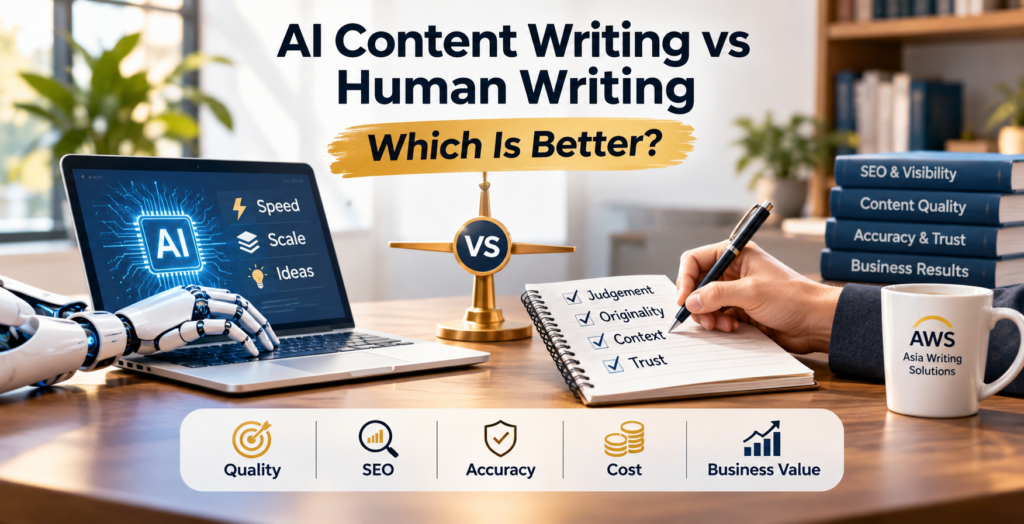
AI content writing vs human writing is not a simple contest between technology and people. AI can help produce and organise content quickly, while human writers contribute judgement, original insight, contextual understanding and editorial responsibility. The better choice depends on the content’s purpose, the risks involved, the quality of the research and what readers need from it.
For businesses, the important question is not simply whether AI can write an article. It is whether the finished content is accurate, useful, distinctive, trustworthy and capable of supporting a real business objective.
In this guide, we compare AI-generated, human-written and AI-assisted content across quality, accuracy, originality, SEO, cost and practical business value. We also explain when each approach makes sense and how a research-led workflow can combine their strengths.
Quick answer: Is AI writing better than human writing?
Neither approach is universally better.
AI writing can be useful for organising information, developing outlines, generating initial drafts, exploring alternative headlines and accelerating repetitive tasks. However, AI output can contain unsupported claims, generic explanations, weak differentiation or language that does not reflect a business’s actual experience.
Human writers can bring contextual judgement, subject knowledge, interviews, lived experience, original analysis and a more deliberate understanding of an audience. But human-written content can also be inaccurate, poorly researched, repetitive or ineffective.
For many business-content projects, a human-led, AI-assisted workflow is worth considering. AI supports research organisation and drafting, while a responsible human process verifies the evidence, develops original insights, checks brand alignment and approves the final content.
The key is to evaluate the finished work—not assume that the label “AI-written” or “human-written” automatically determines its quality.
1. What do AI-written and human-written content actually mean?
AI-generated content
AI tools generate most or all of the text in response to prompts and supplied context. A person may review the result, but substantial human research, rewriting or editorial judgement may be limited.
This approach can be efficient for low-risk, well-defined tasks. Its limitations become more important when the topic requires current evidence, specialist knowledge, original reporting or careful interpretation.
Human-written content
A person develops the content through research, planning, writing and editing. The writer may use ordinary digital tools, search engines and reference materials, but the substantive analysis and writing are led by a human.
The quality depends on the writer’s expertise, the evidence available, the quality of the brief and the editorial process. Human authorship alone does not guarantee accuracy or originality.
AI-assisted, human-reviewed content
AI helps with selected tasks, such as organising research, generating an initial structure or identifying gaps in a draft. A human remains responsible for the argument, verification, originality, context, editorial decisions and approval.
This is not automatically the best approach for every assignment. It is a practical option when AI’s efficiency is useful and human oversight is sufficient to manage the risks.
2. AI writing vs human writing: A practical comparison
| Factor | AI-generated content | Human-written content | AI-assisted, human-reviewed content |
|---|---|---|---|
| Production speed | Often fast for initial drafts | Depends on research and writing complexity | Can reduce drafting time while retaining review |
| Accuracy | Requires fact-checking; errors can sound convincing | Depends on expertise and source quality | Human verification can catch unsupported claims |
| Originality | May repeat familiar explanations unless guided by strong evidence and insight | Can incorporate original analysis, interviews and experience | Can combine efficient drafting with human-developed insights |
| Brand voice | May sound generic without detailed context | Can be tailored through deliberate writing | Can be refined against brand guidelines |
| Subject expertise | Depends on the quality of supplied context and available evidence | Depends on the writer’s actual expertise | Requires qualified human input where specialist judgement matters |
| Cost | May reduce some production costs | Varies with research, experience and scope | Includes AI, research, editorial and quality-control costs |
| Scalability | Can generate large volumes quickly | Scaling requires additional capacity and management | Can improve workflow efficiency if quality controls scale too |
| Accountability | A tool does not replace an accountable editor | Responsibility can be assigned to the writer or editorial team | Human ownership must remain clear |
These are directional tendencies, not guarantees. The result depends on the tool, writer, subject, workflow and standards applied.
A fast draft that needs extensive correction may not save much time. Similarly, a human-written article that contains no original analysis may offer little advantage over generic AI output.
3. Which produces more accurate content?
Accuracy is one of the most important differences to examine, particularly for content involving finance, health, law, technical subjects, business decisions or changing industry information.
Generative AI systems can produce plausible statements without reliably establishing that each statement is true. They may misunderstand a source, invent a detail, use outdated information or present an uncertain claim with excessive confidence.
Google’s guidance on generative AI content emphasises accuracy, quality and relevance, and says AI-generated material should be checked carefully before publication. Read Google Search Central’s guidance on generative AI content.
Human writers can make mistakes too. They may misread research, rely on outdated sources or overlook a qualification. The difference is not that humans are infallible, but that a good editorial process explicitly checks claims against reliable evidence.
For business content, a useful verification process includes:
- Checking statistics against the original report or dataset.
- Confirming publication dates and whether the evidence is still current.
- Distinguishing findings from opinions and assumptions.
- Checking that a source actually supports the claim attributed to it.
- Qualifying findings when the evidence is limited or inconclusive.
- Removing claims that cannot be verified.
Practical conclusion: Do not judge accuracy by the writing method. Judge it by the evidence, verification and accountability behind the final article.
4. Which approach produces more original content?
Originality is more than using different words.
A piece of content can be grammatically polished and still add very little if it repeats explanations that readers can find across dozens of other pages.
AI can help explore a topic, structure information and identify questions to investigate. However, asking a model to summarise the existing consensus is not the same as producing original research or a genuinely distinctive perspective.
Human writers can contribute original thinking through activities such as:
- Interviewing customers, subject specialists or practitioners.
- Analysing primary research and comparing competing findings.
- Drawing on documented professional experience.
- Developing a useful framework or decision-making method.
- Examining why a common recommendation may not work in a particular situation.
- Testing a process and reporting what happened.
AI-assisted work can also be original when people contribute these substantive elements and use AI to support rather than replace the work.
For example, an article comparing AI and human writing becomes more useful when it explains the limitations of existing studies, distinguishes different content workflows and gives readers a practical way to choose between them. Merely repeating that “AI is fast but humans are creative” adds little value.
Google’s people-first content guidance asks creators to consider whether their content provides original information, research, analysis and meaningful value beyond other available pages.
5. Does AI-generated content rank on Google?
Yes, AI-generated content can appear in Google Search. Using AI does not automatically make content ineligible to rank.
Google’s published position is that its systems focus on the quality and usefulness of content rather than banning a particular production method. However, generating large numbers of pages primarily to manipulate rankings, without adding value for users, can violate Google’s spam policies.
Read the official guidance: Google Search Central — Guidance on Generative AI Content.
This means two common claims should be treated cautiously:
- “Google penalises all AI content.” This is not an accurate description of Google’s published policy.
- “AI content ranks just as well, regardless of quality.” This is also unsupported. The finished content still needs to meet users’ needs and provide meaningful value.
What does recent ranking research tell us?
A Semrush study published in April 2026 examined 42,000 blog pages associated with 20,000 keywords. It reported that pages classified as human-written appeared in the number-one position much more frequently than pages classified as fully AI-generated. Read the Semrush study on AI content and search performance.
That result is worth considering, but it needs context. The study classified pages using an AI detector. Such tools can misclassify content, and the observed association does not prove that human authorship itself caused the ranking difference. Differences in originality, expertise, editing, website authority and content strategy may also matter.
The sensible conclusion is not that businesses should avoid AI. It is that they should not assume an AI-generated draft will compete effectively simply because it is well written or easy to produce.
What should businesses optimise for?
Rather than asking whether a page was written by AI, assess whether it:
- Addresses the searcher’s actual question.
- Provides accurate, useful and sufficiently complete information.
- Includes relevant evidence and trustworthy sources.
- Adds something meaningful beyond existing search results.
- Uses clear headings and a logical structure.
- Connects naturally to relevant pages on the website.
- Gives readers an appropriate next step without making unsupported promises.
These are content-quality considerations, not a guaranteed formula for rankings.
6. What about AEO, GEO and AI-powered search?
Businesses increasingly want their content to be understood and surfaced in answer-oriented and generative search experiences as well as conventional search results.
Answer Engine Optimisation (AEO) generally focuses on making useful answers and supporting information easy to identify. Generative Engine Optimisation (GEO) focuses on improving how content and business information may be understood, retrieved or referenced by generative systems.
These labels describe evolving practices rather than guaranteed ranking mechanisms. No writing method can guarantee that an AI platform will cite, mention or recommend a business.
For both conventional and AI-assisted discovery, useful foundations include:
- Clear explanations of the topic and the business’s expertise.
- Accurate and consistent factual information.
- Logical page structure and descriptive headings.
- Relevant supporting sources.
- Clear relationships between related concepts and services.
- Evidence of expertise where the subject requires it.
- Content that genuinely answers the audience’s questions.
AI can help organise information and draft concise explanations. Human review remains important to ensure that the answers are correct, contextual and not misleading.
For a broader view of this approach, see AWS Search Visibility and AWS AI Search Services.
7. Is AI content cheaper than human-written content?
AI can reduce the time required for some content-production tasks. Whether it reduces the total cost of producing effective content depends on what is included in the calculation.
A comparison should consider more than the price of a writing tool or the time needed to generate a draft. Relevant costs may include:
- Topic and audience research.
- Keyword and search-intent analysis.
- Source verification and fact-checking.
- Editing, rewriting and brand alignment.
- Specialist review.
- Image, data or original research development.
- Publishing, monitoring and subsequent updates.
An Ahrefs survey of marketers estimated lower average production costs for AI-generated blog posts than for human-written posts. These are survey-based estimates, not universal prices or a like-for-like guarantee of equivalent quality. Read Ahrefs’ analysis of AI content production costs.
A lower initial production cost is useful only if the output meets the business requirement. If an article needs extensive correction, creates reputational risk or attracts visitors who are unlikely to become customers, the apparent saving may be misleading.
The better measure is the cost of producing content that meets the required standard and serves its intended purpose.
8. When should a business use AI, a human writer or both?
The right approach depends on the task, the consequences of error and the level of original judgement required.
AI may be useful for
- Generating initial outlines and alternative headings.
- Organising notes or material supplied by the team.
- Creating a first draft from a detailed, verified brief.
- Repurposing approved material into different formats.
- Identifying questions that a draft has not yet answered.
- Supporting repetitive formatting and editorial checks.
Human review is still needed where accuracy, context or public-facing claims matter.
Human-led writing is especially valuable for
- Thought leadership based on real experience.
- Interviews and original reporting.
- Complex strategic analysis.
- Sensitive or high-stakes subject matter.
- Content requiring specialist judgement.
- Brand positioning and nuanced persuasive writing.
- Situations where trust depends on the author’s demonstrated expertise.
AI may assist with parts of these tasks, but it should not be treated as a substitute for the necessary expertise or verification.
A hybrid workflow may be appropriate for
- Research-led business blogs.
- SEO content requiring both search-intent alignment and original insight.
- Educational guides.
- Service pages that need accurate business information and clear positioning.
- Content programmes where consistent production matters but quality must remain controlled.
The hybrid approach works only when human review is substantive. Simply asking AI to “check its own work” is not a substitute for independent verification.
9. A practical workflow for producing better content
A responsible AI-assisted content process should make the quality checks explicit.
Step 1: Define the business objective
Identify the audience, the problem the content addresses and the action readers may reasonably take after reading it.
Step 2: Research the topic
Review authoritative sources, current evidence, search intent and relevant competing content. Record which claims are supported and where uncertainty remains.
Step 3: Develop a content brief
Set the central question, scope, target audience, key points, evidence requirements, internal links and editorial standards.
Step 4: Draft with the appropriate method
Use a human writer, AI assistance or a combination depending on the topic’s requirements and risks.
Step 5: Verify the evidence
Check factual claims, statistics, quotations, source links and time-sensitive statements. Remove unsupported claims.
Step 6: Conduct human editorial review
Improve reasoning, clarity, originality, structure, tone and brand alignment. Confirm that the article genuinely helps the intended reader.
Step 7: Optimise and quality-check
Review search intent, headings, metadata, internal links, accessibility and the next step offered to readers. SEO should support the content rather than distort it.
Step 8: Publish and evaluate
Monitor relevant indicators such as search impressions, clicks, engagement and qualified enquiries. Use the results to identify what should be improved. Do not assume that publishing an article guarantees rankings or conversions.
This process takes more care than generating text and publishing it immediately. That care is also what makes the resulting content more useful and defensible.
10. A checklist for choosing the right writing approach
Before selecting a workflow, ask:
- Does this topic require specialist expertise or independent judgement?
- Do we need original interviews, analysis, experience or research?
- Are the facts current, verifiable and supported by reliable sources?
- Would an inaccurate statement create meaningful risk?
- Can the brand voice and audience context be communicated clearly?
- Is there enough time and expertise for a proper editorial review?
- How will we judge whether the finished content achieved its purpose?
If a task is repetitive and low-risk, AI may be sufficient for much of the initial production work, subject to appropriate checks.
If the content requires deep expertise, original reporting or careful judgement, a human-led approach is more appropriate.
If the task benefits from speed but still needs accuracy, differentiation and strategic direction, an AI-assisted workflow with meaningful human oversight may be the better fit.
This checklist is a practical decision aid, not a scientifically validated scoring system. The final decision should reflect the actual project requirements.
Frequently asked questions
Is AI-written content bad for SEO?
Not inherently. Google does not prohibit content simply because AI was used. Content created primarily to manipulate rankings, without meaningful user value, can violate spam policies. Accuracy, usefulness, originality and quality remain important.
Can AI-written articles rank number one on Google?
AI-generated articles can rank in search results, but no writing method guarantees a particular position. Research comparing AI-classified and human-classified pages should be interpreted carefully because classification methods and other ranking factors limit what can be concluded.
Is human-written content always better?
No. Human writers can produce inaccurate, generic or poorly researched work. Their contribution is most valuable when it adds genuine expertise, original thinking, sound judgement and careful editing.
Does AI content cost less?
It can reduce some production costs, especially drafting time. The total cost depends on research, editing, verification, specialist input and the quality standard required.
Should businesses disclose when they use AI?
It depends on the context and the expectations of the audience. Google notes that explaining how content was created can help readers understand its production when that information is relevant. Businesses should avoid misleading readers about authorship, expertise or the evidence behind their claims.
What is the best approach for SEO blogs?
Start with the audience’s needs and the evidence. Use the production method that suits the task, then verify the facts, improve the originality, check search intent and conduct editorial review. AI assistance may help, but it should not replace these responsibilities.
Conclusion: Choose the process that produces the best content
The debate about AI content writing versus human writing often focuses on speed, cost or authorship. For businesses, the more useful question is whether the finished content is accurate, distinctive, relevant to the audience and capable of supporting a real objective.
AI can make parts of content production faster. Human expertise and editorial judgement help determine what should be said, what the evidence supports and whether the final work deserves the reader’s trust.
For many business-content projects, a carefully managed combination of AI assistance and human responsibility is a sensible option. But the workflow should always be chosen according to the task—not adopted as a universal rule.
At Asia Writing Solutions, the relevant principle is straightforward: content should begin with audience needs, research and a clear purpose, then pass through appropriate editorial and quality checks before publication.
Planning a business blog or content programme? Explore AWS Blog Writing Services to understand the research-led approach, or review AWS Search Visibility for a broader view of content and search discovery.
Editorial note: This article provides general information, not a guarantee of search rankings, AI citations, traffic or commercial results. Research findings should be interpreted in the context of their methodology and limitations.